---
title: Lesson 1 · From Madness to Method
url: https://richard-bedenham.github.io/series/madness-to-method/from-madness-to-method/
markdown_url: https://richard-bedenham.github.io/series/madness-to-method/from-madness-to-method/index.md
series: Madness to Method
lesson: 1
author: Richard Bedenham
author_role: Director of PrimalRMS Ltd, a revplus company
---
# From Madness to Method
**About 25 minutes (estimate).** You need a pen and paper. You do not need a calculator.
## The problem
Every morning you open your systems, and each one gives you a different number for the same night. The PMS says one thing. The channel manager says another. Someone on the phone says "busy". You spend the first hour deciding which number to believe, and you still have not decided anything about the price.
The trouble is not a lack of data. It is too much data, with no question to sort it. This lesson gives you a method. Start with a question, find one number you can trust, compare it with something, and then decide.
## What you will learn
You will learn to approach a commercial decision step by step, starting from a question and reliable data, so that your decisions stop depending on whichever number arrived last.
By the end of this lesson:
- I can use a commercial question, with a date range and a decision, to choose which numbers to look at.
- I can explain why two of my systems show different numbers for the same night, and choose the one to decide on.
- I can distinguish data, information, insight and action in statements about my hotel.
**Before you start.** You need nothing. This is the first lesson in the series.
## What do you check first?
Think about a normal morning at your hotel. When you sit down to look at your prices, what do you open first? Write down the screen or report, and what you hope it will tell you.
Keep your answer. You will come back to it at the end of the lesson.
## The morning desk
MyDemoHotel is a fictional 120-room hotel in Crete. Today is Friday 16 October 2026, and it is 08:00. The owner asks a simple question. How full are we on Saturday?
In the workshop, the morning desk had many screens, and each screen showed a different number. There is the PMS (property management system), the system that holds your reservations and your rooms. There is the channel manager, which sends your prices and availability to the websites that sell your rooms. There is the booking engine, the booking page on your own website. There is a reservations list, emails and a phone.
In the workshop, seven sources answered the owner's question with seven different answers.
| Source | It says | Taken at | What it can miss |
|---|---|---|---|
| PMS report | 212 room nights | 23:00 last night | Bookings made since 23:00 |
| Channel manager | 84% occupancy | Live | Groups, phone and reception bookings |
| Booking engine | 38 bookings | 06:00 today | Every channel except your website |
| A booking website's reservations list | 41 bookings | 06:00 today | Every other channel |
| Reservations team | 12? rooms on option | This morning | Options are not confirmed |
| Group contracts | ? rooms | Not known | Rooms not yet entered |
| Morning call | "Busy!", a feeling | 08:00 | It is not a number |
All figures in this lesson are illustrative. In the workshop, the numbers on the screen did not even stay still. Each one changed while you watched it.
Before you read on, look at the table. What do you wonder? Then write down the one number you would give the owner, and why.
## Why the seven numbers disagree
Paste these seven into a spreadsheet, add them up, and the total says #VALUE!. The spreadsheet is right to refuse. Room nights, a percentage, a count of bookings and a feeling are four different measures, and you cannot add them.
Look at the PMS line again. MyDemoHotel has 120 rooms, so 212 room nights cannot be one Saturday. That report is counting something else, perhaps more than one night or the whole stay of every guest who is in on Saturday. Before you compare two numbers, check that they measure the same thing for the same nights.
None of the seven sources is broken. Measured the same way, they still disagree, for two reasons.
1. **They update at different times.** The PMS report ran at 23:00 last night. The channel manager is live. Anything booked in between is in one and not the other.
2. **Some of them miss bookings.** A group contract may sit in an email before anyone enters it. An option is a room held for a guest who has not confirmed yet, so it is not a booking. The channel manager does not see a booking taken by phone or at reception.
### Which number do you decide on?
Decide on the system that holds all confirmed bookings, and say when it was last updated. That is usually the PMS, because bookings from every channel, every group and every phone call end up there once someone enters them.
"212 room nights" on its own tells you very little. "212 room nights, as of 23:00 last night" tells you what you have and how old it is. Before you act on it, run the report again or check what arrived since.
A common mistake is to trust the channel manager because it is live. Live does not mean complete. The channel manager sees only what came through your channels, so a live number can still be too low.
## Start with a question, not a dashboard
A dashboard is a screen that shows many numbers at once. It can show you everything, and that is the problem. Without a question, every number looks equally important, and you end up reading all of them.
The request you receive is often not the real question. "How are we doing?" can hide a worry about one weekend, one price or one group. Find the decision behind the request.
A commercial question has two parts.
- **A date range.** Which nights are you deciding about?
- **A decision.** What will you do differently depending on the answer?
"Check performance" is a topic, not a question. It has no dates and no decision. "Should we change the double room price for Saturday 24 October?" is a commercial question. It names one night and one decision. It also tells you which numbers to open, and which to leave closed.
## Get one reliable number
A reliable number is one you can act on without checking it against three other screens. It has three things.
- It comes from the system that holds all confirmed bookings.
- It carries a time, such as "78 rooms, as of 07:30 today".
- When you compare it with something, both numbers come from the same system, measured in the same way.
Options, rumours and the morning call are not bookings. They can be useful to know. Keep them next to the number, never inside it.
## Choose the indicators that answer the question
A performance indicator is a number that tells you how the hotel is doing. A meaningful indicator is one that helps answer your question. For a question about the price of a future night, this series uses six.
- **Occupancy** is the share of your rooms that are sold. It tells you how much you have sold.
- **ADR** (average daily rate) is the average price of each room sold. It tells you at what price.
- **RevPAR** (revenue per available room) is room revenue spread over every room you could have sold. It joins volume and price in one number.
- **Pickup** is the net change in bookings over a period, which is new bookings minus cancellations. It tells you how fast the night is selling now.
- **Pace** compares what you hold now with what you held at the same point before. It tells you whether you are booking faster or slower than you did.
- **Same time last year** is what you had on the books last year, for the matching night, at the same number of days before arrival. It is the fair comparison for a night that has not happened yet.
"On the books" means the bookings you hold today for that night. Lesson 2 teaches each of these indicators with worked calculations. Total revenue for the month, or the number of emails in the inbox, can be useful elsewhere. They do not tell you whether to change the price of one night.
## From data to action
The same morning holds four different kinds of statement. Telling them apart is the core skill of this lesson.
- **Data** is individual raw records, such as each booking, each cancellation and each rate.
- **Information** is data organised to answer a question. "78 rooms are booked for Saturday 24 October."
- **Insight** is information compared with something that gives it meaning, such as last year or your pace. "We are 18 rooms behind where we were last year, eight days out."
- **Action** is the decision you take because of the insight. "Review the price for Saturday 24 October." Deciding to change nothing is an action too.
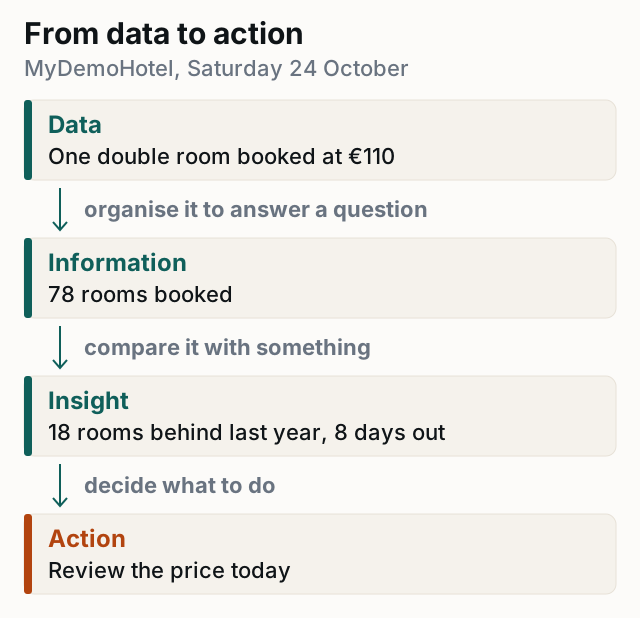
Most mornings stop at information. "We have 78 rooms" feels like an answer, but it does not tell you whether 78 is good or bad. Only a comparison does that. If a statement has no comparison in it, it is not yet an insight.
## Worked example with the owner's message
At 08:00 the owner sends you a message. "How is next Saturday looking? Do we need to do something?" Here is how to turn that message into a decision.
1. **Ask the question.** The owner means Saturday 24 October, and "do something" means the price. So the question is "Should we change the double room price for Saturday 24 October?"
2. **Get one reliable number.** The PMS holds every confirmed booking. It shows 78 rooms, as of 07:30 today. The channel manager shows 76. It is missing two bookings taken by phone, so you do not use it.
3. **Compare.** 78 of 120 rooms is 65%. At the same time last year, 8 days before arrival, the hotel had 96 rooms (80%). You are 18 rooms behind. In the last 7 days the date picked up +2 rooms. In the same 7 days last year it picked up +11.
4. **Decide, and write it down.** Saturday 24 October is behind and slowing, with 8 days left. The action is to review the price today. What the new price should be is Lesson 3. Write one line in a log. "16/10/2026. Saturday 24 October. 78 rooms (PMS, 07:30) against 96 last year. Review price today."
Your reply to the owner is one sentence. "Saturday is 18 rooms behind last year with 8 days to go, so I am reviewing the price this morning."
## A short routine to start with
The four steps in the worked example are a routine you can repeat every morning.
1. Ask the question, with dates and a decision.
2. Get one reliable number, with its time.
3. Compare it with something that gives it meaning.
4. Decide, and write down what you decided and why. "No change" is a decision too.
This is the start. Lesson 4 builds it into a daily review of five stages. You understand your position, identify meaningful changes, investigate the reasons, decide what to do (including no change), and measure the outcome. The line you write down today is what you measure against later.
## Guided practice with three vague requests
Each request below is the kind you hear every week. Turn each one into a commercial question, with a date range and a decision. Then write two or three numbers you would look at first.
1. The owner says, "Check how we are doing."
2. The sales manager says, "We need more bookings in November."
3. The general manager says, "Have a look at the competitors."
Hints, if you need them. Which nights? What decision could change? Which number would tell you whether to make it?
Show the answers
These are model answers. Yours can differ, as long as each has dates and a decision.
1. "Is any night from Friday 23 to Saturday 31 October behind the same time last year, and should we change its price?" Look at rooms booked in the PMS, with its time, and the same time last year.
2. "Which nights in November are behind the same time last year, and should we change the price on any of them?" Look at rooms booked, the same time last year and the pickup over the last 7 days.
3. "Should we change our double room price for Saturday 31 October, given what the hotels near us charge for the same room?" Look at your own pace first, then the competitors' prices for the same room and the same night. Lesson 3 shows how to compare them fairly.
A common mistake is to keep the topic and add a date, as in "Check performance for November." That has dates, but no decision. Ask yourself what you would do differently depending on the answer.
## Independent practice with six statements
Here are six statements about Saturday 31 October at MyDemoHotel. Label each one data, information, insight or action. Do all six before you open the answers.
1. One double room for Saturday 31 October, €95, booked on your website at 21:14 last night.
2. Saturday 31 October has 64 rooms booked, as of 07:30 today.
3. Saturday 31 October picked up 15 rooms in the last 7 days, against 6 in the same 7 days last year.
4. A cancellation of two rooms for Saturday 31 October, received at 06:52.
5. Hold the price for Saturday 31 October, and look at it again on Monday 19 October.
6. The rooms booked for Saturday 31 October so far have an average rate of €104.
Show the answers
1. Data. It is one booking, a single record.
2. Information. It organises all the bookings to answer "how many rooms for Saturday?"
3. Insight. It compares this year's pickup with last year's, which tells you the date is booking faster.
4. Data. One cancellation is a single record.
5. Action. It is a decision. Holding the price is an action, because you chose it.
6. Information. An average organises many bookings, but nothing here compares it with anything.
Statement 6 is the one people most often get wrong. An average sounds like analysis, so it feels like an insight. Ask whether the statement compares the number with something. If it does not, it is information.
## Knowledge check
Do this on your own, with the lesson closed. It uses new requests, new numbers and new statements.
1. On Friday 16 October the owner writes, "The revenue meeting is on Monday. Prepare something on next week." Write a commercial question from this request, and name two numbers you would look at first.
2. It is 08:00. The PMS report, run at 23:00 last night, shows 212 room nights for Friday 13 and Saturday 14 November. The channel manager, which is live, shows 214 for the same two nights. Give the most likely reason for the gap. Which system do you decide on, and what do you write next to its number?
3. Label each statement data, information, insight or action.
1. Room 108 is booked for Friday 6 November at €98, through an online travel agency, a website that sells rooms for many hotels.
2. Friday 6 November has 51 rooms booked in the PMS, as of 07:30 today.
3. The channel manager shows 47 rooms for Friday 6 November.
4. Friday 6 November is 9 rooms ahead of the same time last year.
5. A guest cancelled two rooms for Friday 6 November at 06:40.
6. Keep the price for Friday 6 November, and check the pickup again on Wednesday 21 October.
Show the answers and explanations
1. A good answer has dates and a decision. For example, "Is any night from Monday 19 to Sunday 25 October behind the same time last year, and should we change its price?" Look first at rooms booked in the PMS, with its time, and at the same time last year. "A report on next week" has dates but no decision, so it is still a topic.
2. The two numbers were taken at different times. The PMS report is 9 hours old, and the live channel manager has seen bookings made since 23:00. Decide on the PMS, because it holds all confirmed bookings, including groups and phone bookings. Run the report again, and write the time next to the number, for example "as of 08:00". A common mistake is to choose the channel manager because it is live and higher. It still misses groups and phone bookings, so the full number may be higher again.
3. The labels are as follows.
1. Data. One booking.
2. Information. All the bookings, organised to answer "how many rooms?"
3. Information. It answers the same question from an incomplete system. Being less reliable does not make it data.
4. Insight. It compares this year with the same time last year.
5. Data. One cancellation.
6. Action. A decision, even though the price stays the same.
If you got question 1 wrong, reread "Start with a question, not a dashboard". If you got question 2 wrong, reread "Why the seven numbers disagree". If you labelled 3.3 as data or 3.4 as information, reread "From data to action".
## Use it at your hotel
Pick next Saturday at your own hotel. Fill in this table tomorrow morning, before you change any price.
| Step | Your answer |
|---|---|
| Your question, with dates and a decision | |
| The system that holds all confirmed bookings | |
| Its number for next Saturday, and the time it was last updated | |
| A second system's number, and its time | |
| Is the gap a different time, or missing bookings? | |
| What you compare the number with | |
| Your insight, in one sentence | |
| Your action, including "no change" | |
Now look back at what you wrote under "What do you check first?". Did you open the system that holds all confirmed bookings, or the one that was easiest to reach? If they are different, change the order of your morning.
## Keep learning
- Next, Lesson 2, "Your Hotel Is 65% Occupied. So What?", where you calculate and compare the indicators from this lesson.
- [Hotel Market Intelligence, Rate Shopping and Analytics](https://richard-bedenham.github.io/guides/market-intelligence-and-analytics/), for where market numbers come from, and how to read them.
- [Hotel PMS and Operations: A Complete Practical Guide](https://richard-bedenham.github.io/guides/hotel-operations-and-pms/), for what your PMS holds, and how to keep it complete.
- [Hotel Distribution and Connectivity: A Complete Guide](https://richard-bedenham.github.io/guides/distribution-and-connectivity/), for how channel managers and booking engines connect, and why they can disagree.