Madness to Method · Lesson 4 of 4
The 15-Minute Revenue Management Routine
About 40 minutes (estimate). You need a calculator, and a pen or a spreadsheet for your decision log.
The problem
Every morning there are new bookings, new cancellations and new competitor prices. Many hotels answer this by building the same long report every day. Others look at whatever arrives first, such as an owner's message or one competitor's drop. The first way takes hours. The second way misses the nights that need help.
This lesson gives you a short routine with five stages. It ends every morning with a decision for each night that needs one, and a record you can check later.
What you will learn
You will learn to run a short daily review that ends in a decision and a measured outcome, so that good judgement becomes a habit.
By the end of this lesson:
- I can carry out the five-stage daily review on a set of dates and record a decision for each, including "no change".
- I can construct my own review checklist from the five stages for my hotel.
Before you start. You need Lessons 2 and 3. This lesson uses occupancy, ADR, RevPAR, pickup and the same time last year from Lesson 2, and comparable competitor prices from Lesson 3.
Remember Lessons 2 and 3
Answer these two from memory before you read on.
- A night has 90 of 120 rooms sold and €9,900 room revenue. What are its ADR and RevPAR?
- The hotel next door drops its price, and the owner says "match it". Name two things you check before you decide.
Show the answers
- ADR = €9,900 ÷ 90 = €110. RevPAR = €9,900 ÷ 120 = €82.50. RevPAR divides by every room you have, sold or not.
- Any two of these. Is the competitor's price comparable, with the same room type, rate conditions and board, and still on sale? How is your own pace against the same time last year? What is demand doing for the date? One competitor's price is never the whole reason.
You have 15 minutes. Where do you spend them?
MyDemoHotel is the 120-room hotel from the workshop, in Crete. Today is Friday 16 October 2026. These are the next 14 nights, as of this morning.
Before you read on, pick up to four nights you would look at today, and write down why. You will come back to your answer at the end of the worked morning.
| Night | Days | Booked | Occ | ADR | Pickup | STLY | LY pickup | Rate | Note |
|---|---|---|---|---|---|---|---|---|---|
| Sat 17 | 1 | 94 | 78% | €150 | +12 | 84 | +8 | €165 | median €176 |
| Sun 18 | 2 | 84 | 70% | €118 | +5 | 86 | +6 | €130 | |
| Mon 19 | 3 | 48 | 40% | €98 | +3 | 50 | +4 | €110 | |
| Tue 20 | 4 | 62 | 52% | €112 | +3 | 72 | +8 | €140 | €110 to €135 |
| Wed 21 | 5 | 58 | 48% | €105 | +6 | 55 | +7 | €125 | |
| Thu 22 | 6 | 66 | 55% | €108 | +8 | 64 | +9 | €125 | |
| Fri 23 | 7 | 90 | 75% | €122 | +10 | 92 | +12 | €145 | |
| Sat 24 | 8 | 78 | 65% | €110 | +2 | 96 | +11 | €145 | €120 to €135 |
| Sun 25 | 9 | 60 | 50% | €104 | +6 | 63 | +8 | €120 | |
| Mon 26 | 10 | 36 | 30% | €96 | +3 | 39 | +5 | €105 | |
| Tue 27 | 11 | 40 | 33% | €97 | +5 | 42 | +6 | €110 | |
| Wed 28 | 12 | 45 | 38% | €100 | +6 | 44 | +6 | €115 | |
| Thu 29 | 13 | 42 | 35% | €102 | +4 | 54 | +5 | €115 | group of 15 last year |
| Fri 30 | 14 | 70 | 58% | €118 | +9 | 66 | +7 | €140 |
What the columns mean:
- Days is days to arrival.
- Booked is rooms on the books today, out of 120.
- Occ is occupancy.
- Pickup is the net change in rooms booked over the last 7 days.
- STLY is rooms booked at the same time last year, for the matching night at the same number of days to arrival.
- LY pickup is the pickup in the same 7 days last year.
- Rate is your current price for a double room with breakfast and free cancellation.
- Note is what comparable hotels charge for that same room and conditions, from a rate shopping tool, or something you know about the night. The median is the middle price.
All figures in this lesson are illustrative. On a phone, the table scrolls sideways inside its box.
What 15 minutes is, and is not
Fifteen minutes is an estimate for a first look. Its job is to decide where your time goes today. On most mornings, most nights need nothing. The routine finds the few that do, and gives each one a decision.
It is not the whole job. Some days one night needs an hour, for example when a group asks for 30 rooms. Some work needs its own time in the week, such as the forecast, next season's prices and contracts with tour operators. The routine tells you when that longer work is needed. It does not replace it.
Expect it to take longer at first. It gets shorter when your numbers come from one place, at one time, every morning.
The five stages
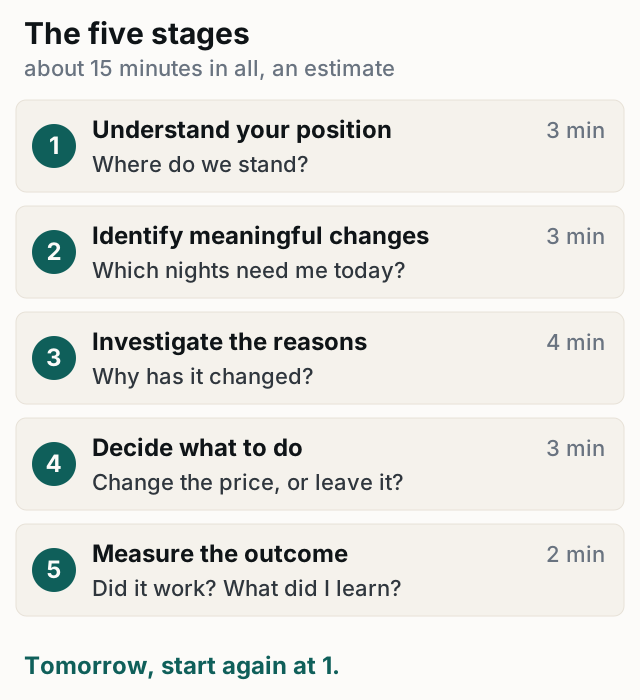
The minutes are estimates. Use them as limits, so that no one stage eats the morning.
1. Understand your position
Look at occupancy, ADR, RevPAR and room revenue for the coming nights, and at your future booking position. Your future booking position is what you hold on the books for nights that have not arrived yet, compared with the same time last year.
For a group of nights, add up first, then divide. Rooms available for 14 nights is 120 × 14 = 1,680.
- Occupancy = rooms sold ÷ rooms available × 100
- ADR = room revenue ÷ rooms sold
- RevPAR = room revenue ÷ rooms available
2. Identify meaningful changes
Look for unusual pickup, shifts in pace, changes in demand, and the dates that need attention. Use a rule you write down in advance. A rule stops you reacting to every small movement, and it makes today's review the same as tomorrow's.
The rule in this lesson flags a night when any one of these is true:
- It is 10 rooms or more behind, or ahead of, the same time last year. For MyDemoHotel, 10 rooms is about 8% of the hotel.
- Its pickup in the last 7 days is less than half of last year's pickup in the same 7 days. The date is slowing.
- Its pickup in the last 7 days is at least double last year's. Something unusual is happening.
Also flag any night where you know demand has changed, for example an event that was announced or cancelled. Set the numbers for your own hotel. A 40-room hotel might use 4 rooms, which is 10% of the hotel.
3. Investigate the reasons
For each flagged night, find out why. Look in four places.
- Historical performance. What happened on the matching night last year? Was there an event, or a group?
- Market conditions. What do comparable hotels charge for the same room and conditions, and are they still on sale? What is demand doing?
- Segments. A segment is a group of guests who book in a similar way, such as groups, tour operators, or leisure guests booking online. Which segment is ahead or behind?
- Pricing. Did you change the price recently? What happened to pickup after the change?
Stop when you have a reason that explains the numbers. If you cannot find one in a few minutes, put the night on today's list for longer work.
4. Decide what to do
For each flagged night, choose one action: raise the price, lower it, or make no change. "No change" is a decision when it has a reason and a date to look again. Write the reason down, with at least two pieces of evidence.
5. Measure the outcome
Record each decision in a decision log: what you changed, why, what you will measure, and when you will look again. Look again 3 days and 7 days after the decision, as in Lesson 3, and on the morning after the night itself. Measure pickup after the change against the same days last year. On the morning after the night, record the final rooms and revenue.
Each morning, stage 5 also means reading the log rows that are due today. What you learn from them goes into tomorrow's decisions.
Worked example: Friday 16 October at MyDemoHotel
Here is the whole routine on the 14 nights in the table above.
Stage 1: the position
The 14 nights hold 873 rooms of the 1,680 available, and €99,058 room revenue.
- Occupancy = 873 ÷ 1,680 × 100 = 52%
- ADR = €99,058 ÷ 873 = €113.47
- RevPAR = €99,058 ÷ 1,680 = €58.96
- Future booking position. Last year held 907 rooms at this point, 54%. The 14 nights are 34 rooms behind.
The total tells you that something is behind. It does not tell you which night. That is stage 2.
Stage 2: the nights that meet the rule
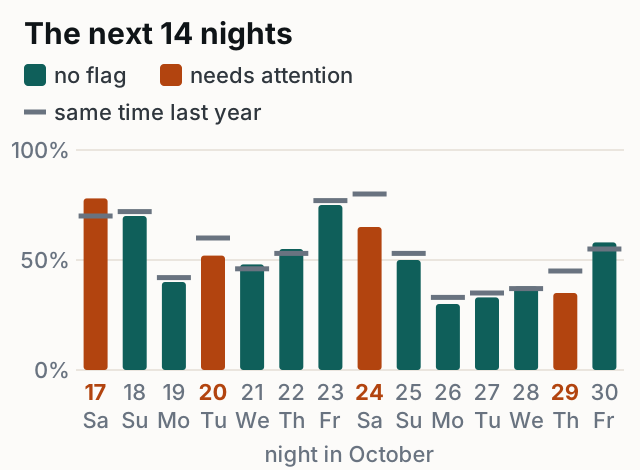
Four nights meet the rule.
- Saturday 17 October is 10 rooms ahead, with 94 against 84.
- Tuesday 20 October is 10 rooms behind, with 62 against 72. It is also slowing, with +3 against +8 last year.
- Saturday 24 October is 18 rooms behind, with 78 against 96. It is also slowing, with +2 against +11 last year.
- Thursday 29 October is 12 rooms behind, with 42 against 54.
The other ten nights are within 10 rooms of last year, and their pickup is normal. They get no more time today. Monday 26 October is only 30% booked, but it is 3 rooms behind and picking up normally. A low number on its own is not a change.
Stage 3: the reasons
Saturday 17 October. This is the Saturday from Lesson 3. It has 12% more bookings than last year, and it picked up 12 rooms in 7 days against 8. Demand is strong. The comparable hotels' median is €176, and your €165 is €11 below it. The night is tomorrow, and it is still selling.
Tuesday 20 October. Fewer people are booking for this date than last year. It is 52% booked against 60%, and it picked up +3 against +8. The comparable hotels charge €110 to €135. Your €140 is above all of them.
Saturday 24 October. This is the Saturday from Lesson 2. Your decision log shows that you raised its price from €125 to €145 on Friday 9 October, 7 days ago. Since then it picked up 2 rooms, against 11 in the same 7 days last year. The comparable hotels charge €120 to €135, so you are €10 above the highest. The most likely reason for the slowdown is your own price rise. That is a judgement, and stage 5 will test it.
Thursday 29 October. Last year's 54 rooms included a conference group of 15 rooms, booked in the spring. There is no group this year. Without the group, last year had 39 rooms at this point, and this year is 3 rooms ahead. Pickup is normal, at +4 against +5.
Stage 4: the decisions
- Saturday 17 October. Raise from €165 to €175. The night is 10 rooms ahead with 12% more bookings, it picked up faster than last year, and €175 is still below the €176 median. In the workshop, this was the decision too.
- Tuesday 20 October. Lower from €140 to €125. The night is behind and slowing, with 4 days left, and it is priced above every comparable hotel. €125 sits inside the market's range.
- Saturday 24 October. Lower from €145 to €130. The night is 18 rooms behind, the rise a week ago stopped its pickup, and it is €10 above the market. This takes back most of last week's rise. That is fine, because the log showed the rise did not work.
- Thursday 29 October. No change, keep €115. The gap is last year's group, not this year's demand. Without the group the night is ahead, and its pickup is normal. Look again on Monday 19 October.
The ten nights without a flag keep their prices. They need no log row today.
Now look at the four nights you chose before the worked morning. Did you choose the low nights, such as Monday 26 at 30%? Did you spot that Thursday 29 is behind only because of a group?
Stage 5: the decision log
This morning's log rows:
| Night | Change | Why | Measure | Look again |
|---|---|---|---|---|
| Sat 17 Oct | €165 to €175 | 10 ahead, +12 against +8, below the €176 median | Final result | Sun 18 |
| Tue 20 Oct | €140 to €125 | 10 behind, +3 against +8, above every comparable hotel | Pickup against last year | Mon 19, Wed 21 |
| Sat 24 Oct | €145 to €130 | 18 behind, +2 against +11 since the rise, €10 above the market | Pickup against last year | Mon 19, Fri 23, Sun 25 |
| Thu 29 Oct | No change, €115 | The gap is last year's group of 15. Without it, 3 ahead | Pickup against last year | Mon 19, Fri 23, Fri 30 |
And this is last week's row for Saturday 24 October, with its result filled in this morning:
| Decided | Change | Result after 7 days | What you learn |
|---|---|---|---|
| Fri 9 Oct | €125 to €145 | +2 rooms against +11 last year | A €20 rise above the market, 15 days out, most likely stopped the pickup |
Without that row, you would see a slow Saturday and not know why. With it, the reason takes one minute to find.
Guided practice with the worked morning
Use the table and the worked morning. Try each one before you open the answer.
- The 14 nights are 34 rooms behind the same time last year. How many of those 34 rooms do the four flagged nights explain?
- Friday 30 October picked up 9 rooms against 7 last year. Does it meet the rule?
- On Monday 19 October you look again at Tuesday 20 October. What do you compare?
Show the answers
- Saturday 17 is 10 ahead, and the other three are 10, 18 and 12 behind. That is 40 behind and 10 ahead, so 30 of the 34 rooms. The other ten nights explain only 4 rooms between them. This is why stage 2 matters. The total pointed at a problem, and the rule found where it is.
- No. It is 4 rooms ahead, which is less than 10. And +9 is not double +7, which would be +14. Faster than last year is not the same as unusual.
- The rooms picked up since Friday's change, against the pickup in the same days last year. Then the rooms booked, against the same time last year. If pickup is now close to last year's, the change is working. If it is not, you have 1 night left to act.
Independent practice with the next seven nights
Here are the seven nights after the worked morning, Saturday 31 October to Friday 6 November. Today is still Friday 16 October. Use the same rule. Work out every answer yourself before you open it.
| Night | Days | Booked | Occ | ADR | Pickup | STLY | LY pickup | Rate | Note |
|---|---|---|---|---|---|---|---|---|---|
| Sat 31 | 15 | 64 | 53% | €104 | +15 | 58 | +6 | €125 | €120 to €140 |
| Sun 1 | 16 | 52 | 43% | €110 | +6 | 50 | +5 | €125 | |
| Mon 2 | 17 | 30 | 25% | €92 | +2 | 32 | +3 | €100 | |
| Tue 3 | 18 | 54 | 45% | €95 | +13 | 48 | +6 | €105 | €120 to €135 |
| Wed 4 | 19 | 44 | 37% | €98 | +5 | 42 | +5 | €110 | |
| Thu 5 | 20 | 38 | 32% | €100 | +2 | 50 | +6 | €125 | €100 to €115 |
| Fri 6 | 21 | 51 | 43% | €112 | +6 | 42 | +5 | €130 |
When you investigate, this is what you find:
- Saturday 31 October. 8 of the 15 rooms picked up in the last 7 days are one wedding party, booked direct.
- Tuesday 3 November. The new bookings are many small bookings. There is no group.
-
Thursday 5 November. There was no group or event on the matching night last year, and there is none this year.
-
Stage 1. Calculate the rooms sold, room revenue, occupancy, ADR and RevPAR for the seven nights, and compare the rooms with the same time last year.
- Stage 2. Which nights meet the rule, and why?
- Stage 3. What is the reason for each flagged night?
- Stage 4. Decide for each flagged night, with two pieces of evidence.
- Stage 5. Write the decision log row for Tuesday 3 November.
Show the answers
- 333 rooms sold of 840 available (120 × 7). Room revenue €34,090. Occupancy 333 ÷ 840 × 100 = 40%. ADR €34,090 ÷ 333 = €102.37. RevPAR €34,090 ÷ 840 = €40.58. Last year held 322 rooms at this point, 38%, so the seven nights are 11 rooms ahead.
- Three nights meet the rule. Saturday 31 October picked up +15 against +6, more than double. Tuesday 3 November picked up +13 against +6, more than double. Thursday 5 November is 12 rooms behind (38 against 50), and slowing (+2 against +6, less than half). Friday 6 November is 9 rooms ahead, just under the rule, so it is not flagged.
- Saturday 31 has one wedding party. Without its 8 rooms, the pickup is +7 against +6, which is normal. Tuesday 3 has real demand from many guests. The night is 6 ahead, and it is priced below the comparable hotels. Thursday 5 is behind with no group or event to explain it, and your €125 is above every comparable hotel (€100 to €115).
- Saturday 31 October. No change, keep €125. The fast pickup is one booking, not a change in demand, and the night is 6 ahead. Look again on Monday 19 October. Tuesday 3 November. Raise from €105 to €115. It is ahead and booking more than twice as fast as last year, and €115 is still below the comparable hotels (€120 to €135). Thursday 5 November. Lower from €125 to €110. It is 12 behind and slowing, and €110 is inside the market's range.
- A good row looks like this.
| Night | Change | Why | Measure | Look again |
|---|---|---|---|---|
| Tue 3 Nov | €105 to €115 | 6 ahead, +13 against +6, below the market | Pickup against last year | Mon 19, Fri 23, Wed 4 |
The common mistake is to raise Saturday 31 October because of the +15. Stage 3 exists for this. One group or wedding can look like a rush of demand. If you got question 2 wrong, reread "2. Identify meaningful changes". If you got question 4 wrong, reread "3. Investigate the reasons".
Knowledge check
Do this on your own. It uses the 40-room hotel from the Lesson 2 knowledge check. Today is Friday 16 October 2026. The rule uses 4 rooms instead of 10. The two pickup tests stay the same.
| Night | Days | Booked | Occ | ADR | Pickup | STLY | LY pickup | Rate | Note |
|---|---|---|---|---|---|---|---|---|---|
| Mon 9 | 24 | 14 | 35% | €90 | +2 | 15 | +2 | €100 | |
| Tue 10 | 25 | 12 | 30% | €88 | +1 | 12 | +1 | €100 | |
| Wed 11 | 26 | 20 | 50% | €105 | +5 | 14 | +2 | €110 | conference, €140 to €170 |
| Thu 12 | 27 | 22 | 55% | €115 | +5 | 17 | +2 | €135 | conference, €140 to €170 |
| Fri 13 | 28 | 26 | 65% | €120 | +1 | 30 | +4 | €135 | €105 to €120 |
When you investigate, this is what you find:
- Wednesday 11 and Thursday 12 November. A medical conference is in town on both nights. It was not there last year.
- Thursday 12 November. You raised its price from €110 to €135 on Monday 12 October. 3 of its 5 new rooms were booked after the rise.
-
Friday 13 November. There is no event, and no group last year.
-
Stage 1. Calculate the rooms sold, room revenue, occupancy, ADR and RevPAR for the five nights, and compare the rooms with the same time last year.
- Stage 2. Which nights meet the rule, and why?
- Stage 3. What is the reason for each flagged night?
- Stage 4. Decide for each flagged night, with two pieces of evidence. At least one decision should be "no change", with its reason.
- Stage 5. Write the decision log row for Friday 13 November.
- A colleague says: "I did the routine in 15 minutes, so the revenue work is done for today." What is wrong with that?
- Fill in your own checklist and the first row of your own decision log, in "Use it at your hotel" below.
Show the answers and explanations
- 94 rooms sold of 200 available (40 × 5). Room revenue €10,066. Occupancy 94 ÷ 200 × 100 = 47%. ADR €10,066 ÷ 94 = €107.09. RevPAR €10,066 ÷ 200 = €50.33. Last year held 88 rooms at this point, 44%, so the five nights are 6 rooms ahead.
- Three nights. Wednesday 11 is 6 ahead (20 against 14) and picked up +5 against +2, more than double. Thursday 12 is 5 ahead (22 against 17) and also +5 against +2. Friday 13 is 4 behind (26 against 30) and slowing (+1 against +4, less than half). Monday 9 and Tuesday 10 do not meet the rule.
- Wednesday 11 and Thursday 12 have new demand from the conference. Thursday is still selling after its rise. Friday 13 is behind and slowing, with no event to explain it, and your €135 is above every comparable hotel (€105 to €120).
- Wednesday 11. Raise from €110 to €135. The conference is new demand, the night is ahead and fast, and €135 is still below the comparable hotels (€140 to €170). Thursday 12. No change, keep €135. You raised it 4 days ago, and 3 of its 5 new rooms came after the rise. Measure the last decision before you make another one. Look again on Monday 19 October. Friday 13. Lower from €135 to €120. It is behind and slowing, and €120 is inside the market's range. Other decisions can earn credit if each rests on the right evidence. "A competitor moved" on its own does not.
- The model row for Friday 13 November is in the table after these answers.
- The routine is a first look that decides where to spend time. It found the nights that need a decision. Longer work, such as a group request, the forecast or next season's prices, still needs its own time.
- A good checklist has all five stages, the numbers you look at in each, where each number comes from at your hotel, and minutes for each stage as an estimate. A good log row has the night, the change or "no change", the evidence, what you will measure, and when you will look again.
The model log row for question 5:
| Night | Change | Why | Measure | Look again |
|---|---|---|---|---|
| Fri 13 Nov | €135 to €120 | 4 behind, +1 against +4, above every comparable hotel | Pickup against last year, then the final result | Mon 19, Fri 23, Sat 14 |
If you got question 2 wrong, reread "2. Identify meaningful changes". If you raised or lowered Thursday 12, reread "5. Measure the outcome". If you got question 1 wrong, reread "1. Understand your position", and Lesson 2 for the formulas.
Use it at your hotel
Build your own checklist. Write where each number comes from at your hotel, and how long each stage should take. Take every number from the same system at the same time, as Lesson 1 showed.
| Stage | Numbers to look at | Where they come from at my hotel | Minutes (estimate) |
|---|---|---|---|
| 1. Understand your position | Occupancy, ADR, RevPAR, revenue, rooms against the same time last year | ||
| 2. Identify meaningful changes | Your rule, with the gap in rooms and the two pickup tests | ||
| 3. Investigate the reasons | Last year's night, comparable hotels' prices, segments, your recent price changes | ||
| 4. Decide what to do | Raise, lower or no change, with two pieces of evidence | ||
| 5. Measure the outcome | Log rows due today, pickup since each change |
Then start your decision log, and keep it every morning.
| Decided | Night | Change, or no change | Why | Measure | Look again | Result |
|---|---|---|---|---|---|---|
Run the routine every morning for two weeks. Then read the log, and compare your decisions with what happened. Change your rule if it flags too many nights, or misses nights you later wished you had seen.
Keep learning
- Back to Lesson 1, "From Madness to Method", if your systems show different numbers for the same night.
- Back to Lesson 2, "Your Hotel Is 65% Occupied. So What?", for occupancy, ADR, RevPAR, pickup and the same time last year.
- Back to Lesson 3, "The Price Is Not the Strategy", for comparable competitor prices and how to justify a decision.
- Hotel Revenue Management: A Complete Practical Guide, for forecasting, segments and the longer work the routine points you to.
- Hotel Market Intelligence, Rate Shopping and Analytics, for where market prices come from, and how to read them.
- Hotel PMS and Operations: A Complete Practical Guide, for getting the numbers for stage 1 from one place, at one time.