Madness to Method · Lesson 3 of 4
The Price Is Not the Strategy
About 30 minutes (estimate). You need a calculator, and the Saturday 24 October numbers from Lesson 2.
The problem
A competitor drops its price. Within minutes someone asks you to match it. Someone else wants to hold, and a third person wants to go up. Each of them is looking at one signal.
A price is the last step of a decision, not the decision itself. The decision comes from your own demand, your pace, the market and what you want the night to achieve. A competitor's price is one piece of that evidence, and only if it is a fair comparison. This lesson shows you how to read all of it before you touch the price.
What you will learn
You will learn to reason about a price from demand, the market and your own objectives, so that competitor prices inform your decision instead of making it.
By the end of this lesson:
- I can judge whether a competitor's price is comparable to mine (room, rate conditions, board, availability).
- I can justify a decision to raise, hold or lower a price with evidence from demand, pace and the market.
- I can describe how I would measure whether a pricing decision worked.
Before you start. You need Lesson 2: occupancy, ADR, pickup and same time last year. Nothing else.
Remember Lessons 1 and 2
Answer these two from memory before you read on.
- Your PMS shows 78 rooms for a night. Your channel manager shows 76. Which one do you decide on, and why?
- A date picked up +2 rooms in the last 7 days. In the same 7 days last year it picked up +11. Is it booking faster or slower than last year?
Show the answers
- The PMS, because it holds every confirmed booking. Say the time you read it. The channel manager can miss bookings taken by phone or for groups.
- Slower. +2 against +11 means last year was booking more than five times as fast at this point.
11:30, and everyone has an answer
In the workshop, it is 11:30 on Friday 16 October 2026 at MyDemoHotel, the 120-room hotel in Crete. The hotel next door has just dropped its double room for Saturday 17 October to €129. Your price for the same room is €165.
Three messages arrive.
| Who | Says | Because they saw |
|---|---|---|
| The owner, on WhatsApp | "Match it!" | Next door at €129 |
| The general manager | "Hold it?" | A report that says 78% full |
| Sales | "Go up?" | A group of 40 that might book |
Everyone asks, and nobody agrees.
Before you read on, decide. Match it, hold it, or go up? Write down your answer and your reason.
All figures in this lesson are illustrative.
Read the situation before the price
Each of the three people is looking at one signal. The owner sees one competitor. The general manager sees how full Saturday is, but not how fast it is selling. Sales has heard about a group that is not in any system yet. To decide, you need the whole situation. It has four parts: your demand, your history, the market and your objective.
Demand and booking behaviour
Demand is how many people want to stay on your dates. You cannot see it directly. You see it through booking behaviour, which is how many bookings arrive, how fast they arrive, and how many cancel.
Lead time is the number of days between the day a guest books and the day they arrive. Every hotel has its own pattern. Some nights fill months ahead, and some fill in the last week. So the same number of rooms on the books can be strong for one date and weak for another.
This is why Lesson 2's pace and pickup come first. If a date is booking faster than last year, demand is probably stronger. If it is booking slower, demand is probably weaker, or your price is putting people off.
Historical patterns
History tells you what a date normally still sells from today. In Lesson 2, last year's Saturday 25 October held 96 rooms 8 days out and finished with 108. So last year sold 12 more rooms in its final 8 days. That tells you how much time and demand are left, which matters as much as where you stand now.
Use history as a guide, not a promise. An event, a new hotel nearby or a change in flights can make this year different.
Market intelligence
Market intelligence is what you know about the hotels your guests compare you with: their prices, whether they still have rooms, and how those change. Many hotels collect prices with a rate shopping tool. You can also check the hotels' own websites and the booking sites your guests use.
The group of hotels you compare yourself with is your competitive set. Choose hotels that your guests really consider instead of you, not every hotel in the area.
Compare like with like
A competitor's price is only comparable to yours when it is for the same product. Check four things.
| Check | Comparable when | Example that is not comparable |
|---|---|---|
| Room type | Same kind of room | Their single room against your double |
| Rate conditions | Same cancellation rules and length of stay | Their non-refundable price against your free-cancellation price, or a two-night minimum against your one night |
| Board | Same meals included | Their room-only price against your price with breakfast |
| Availability | Still on sale for that night | A hotel that is sold out has no price to compare |
A price that fails any check is not wrong. It is a different product. Leave it out of the comparison, or adjust for the difference if you know exactly what it is worth.
A sold-out hotel is still useful. It has no price, but it tells you that demand for that night is strong.
The market median
One competitor's price is noise. The market is the whole competitive set. A simple way to read it is the median. Sort the comparable prices that are still on sale, and take the middle one. With an even number of prices, take the point halfway between the two middle ones.
The median moves little when one hotel does something unusual. That is why it suits a morning when one competitor has just dropped.
Market positioning
Positioning is where you choose to sit in your market: below the median, on it, or above it. It should follow your product. A hotel with better rooms, views or reviews can sit above the median. A hotel with less to offer may need to sit below it.
Decide your usual position once, then move away from it for a reason in your own numbers, not because one hotel moved.
Customer segments
A segment is a group of guests who book in a similar way. Examples are leisure couples, groups, and guests who book direct on your own website. Ask which segments are still likely to book this night, and what each one compares.
A couple booking direct compares the price on your website with what they see elsewhere. A group asks for one price for many rooms. A group can fill a weak night. On a strong night it can take rooms you would have sold for more. A group that "might" book is not on the books. Ask for dates, rooms and a price, then judge it like any other piece of evidence.
Pricing objectives
Before you change a price, say what you want the night to achieve.
- On a weak night, the objective is often to fill rooms that would otherwise stay empty.
- On a strong night, the objective is often to protect the rate, because the rooms will sell anyway.
The same competitor drop means different things on these two nights. That is why the objective comes before the price.
When to change the price, and when to hold
Change the price when your own evidence has moved. Pace and pickup are ahead of or behind last year, demand is rising or falling, and the comparable market supports the move. Also make sure there is enough time left for the change to have an effect.
Hold the price when your pace is on track and only one competitor has moved, or when the move is only in prices that are not comparable. Also hold when you changed the price recently and have not yet measured the result.
Your limits are the lowest and highest price you will accept for a room, set in advance. Every change stays inside them.
Matching a competitor is sometimes right. It is right when your own evidence says so, not because they moved first.
Worked example with Saturday 17 October
Here is the evidence for Saturday 17 October, one piece at a time. Every competitor price is for a double room with breakfast and free cancellation, the same as yours.
- Your bookings. In the workshop, Saturday has 12% more bookings than last year. The general manager's 78% is right, but on its own it says nothing about pace.
- The forecast. The forecast is 94% occupancy.
- Demand. Demand for these dates is rising.
- The market. Next door has dropped to €129. Hotel B is at €174, Hotel C at €178 and Hotel D at €189. Hotel E is sold out.
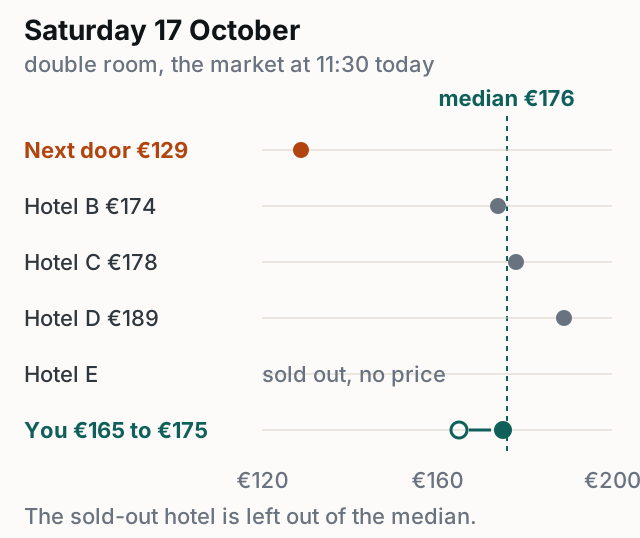
All four prices on sale are comparable. Sorted, they are €129, €174, €178 and €189. The two middle prices are €174 and €178, so the median is €176. Hotel E is left out of the median because it has no price, but its sell-out says demand is strong.
Now put the evidence together.
| Evidence | What it says | Points to |
|---|---|---|
| Bookings | 12% more than last year | Up |
| Forecast | 94% occupancy | Up |
| Demand | Rising | Up |
| Market | Median €176, one hotel sold out | Up, towards the market |
| Next door | Dropped to €129 | Down |
| Your price | €165, €11 below the median |
One signal says down. Four say up. Saturday is a strong night, so the objective is to protect the rate.
In the workshop, the decision was to go up €10, from €165 to €175. That puts you €1 below the market median, inside your limits of €120 to €260. The reply to the owner fits in one line. "No. We have 12% more bookings than last year. Up to €175."
The reply has a decision and a number behind it. That is the habit to build.
Measure the decision
A decision is not finished when you change the price. It is finished when you know whether it worked.
What to compare. Look at the pickup and the price after the change. Compare them with the date's own position before the change, and with the same time last year.
- If you raised the price, check that bookings still arrive. Pickup close to last year's at the higher price means the raise worked.
- If you lowered the price, check that pickup improved. If it did not, price was not the problem, and you need to look again at demand and the market.
- If you held, check that the date stayed on pace.
When to look. Set the dates when you make the decision. For a date more than a week away, look after 3 days and after 7 days. Today is Friday 16 October, so that means Monday 19 October and Friday 23 October. For a date only days away, look sooner, such as later today and tomorrow morning. Always leave enough time to act again.
Write it down. Write one line in a log: the date, the old price, the new price, the reason, and the day you will look again. After the night, add the final result. Over a few weeks the log shows which of your decisions work.
For Saturday 17 October there is only one day left. So you look again this afternoon and tomorrow morning. After the night you compare the final occupancy with the 94% forecast and with last year's final result.
Guided practice with Saturday 24 October
Lesson 2 ended with a question. What exactly should you do with Saturday 24 October? Here are Lesson 2's numbers, and nothing more.
| Saturday 24 October | |
|---|---|
| Days to arrival | 8 |
| Rooms booked | 78 of 120 (65%) |
| ADR | €110 |
| Same time last year | 96 rooms (80%) |
| Pickup, last 7 days | +2 rooms |
| Pickup, same 7 days last year | +11 rooms |
Try each question before you open the answers.
- Does the evidence point to raise, hold or lower? Give two numbers.
- What do you still need before you can choose the new price?
- Say you change the price today. When do you look again, and what do you compare?
Show the answers
- It points to lower, or at least it rules out raising. The date is 18 rooms behind the same time last year (78 against 96) and booking slower (+2 against +11). With 8 days left, holding means hoping, without a reason, that the next week will be different. If the next 8 days go like last year's, the date finishes at 90 rooms (75%).
- The comparable market for Saturday 24 October. That means the prices of your competitive set for the same room, the same conditions and the same board, still on sale, and their median. You also need your limits, and what demand for the date is doing. Lesson 2 gives none of these, so you cannot yet say how much. Notice also that €110 is the ADR, the average of what you have already sold. It is not the price on sale today.
- On Monday 19 October and Friday 23 October, 3 and 7 days after the change. Compare the pickup since the change with the pickup in the same days last year. If the gap of 18 rooms is not closing by Monday, look again at the market and at what is stopping guests from booking.
A common mistake is to go straight to "lower it to the cheapest competitor". The evidence tells you the direction. The comparable market and your limits tell you how far.
Independent practice with Tuesday 20 October
In the workshop, the second case was Tuesday 20 October, 4 days away. Your double room with breakfast and free cancellation costs €140. Your limits are €120 to €260. Work out every answer yourself before you open it.
| Tuesday 20 October | |
|---|---|
| Booked today | 52% |
| Same time last year | 60% |
| Booking speed | Slower than last year |
| Demand for the date | Falling |
| Competitor | Price | Product |
|---|---|---|
| Hotel A | €135 | Double, breakfast, free cancellation |
| Hotel B | €125 | Double, breakfast, free cancellation |
| Hotel C | €110 | Double, breakfast, free cancellation |
| Hotel D | €95 | Double, room only, non-refundable |
Hotel D is added for this practice. The workshop gave the other three.
- Which competitors are comparable to your price? Give the reason for any that are not.
- What is the median of the comparable prices? What would it be if you wrongly included Hotel D?
- Raise, hold or lower? Choose a price and give at least two pieces of evidence.
- When will you look again, and what will you compare?
Show the answers
- Hotels A, B and C are comparable. Hotel D is not comparable, for two reasons. It sells room only, without breakfast, and its price is non-refundable.
- Sorted, the comparable prices are €110, €125 and €135, so the median is €125. With Hotel D, the four prices are €95, €110, €125 and €135, and the median falls to €117.50. One wrong comparison moves the market by €7.50.
- Lower, to €125. You are behind last year (52% against 60%). Bookings are slower and demand is falling. And at €140 you are above every comparable competitor and €15 above the median. Tuesday is a weak night, so the objective is to fill rooms. In the workshop, the decision was €140 to €125. Going to €110 or €95 would be below your lowest limit of €120, and it would follow the cheapest hotels, not the market.
- Monday 19 October, 3 days after the change and the day before arrival. Then again on the morning of the night. Compare the pickup since the change with the same days last year, and check whether the gap to last year's 60% is closing. After the night, compare the final result with last year's.
A common mistake is to keep Hotel D in the comparison because it is the cheapest, and then call the market lower than it is. Another is to refuse to lower because "we never match". Here your own evidence says lower, so lowering is right. If you got question 1 or 2 wrong, reread "Compare like with like".
Knowledge check
Do this on your own. It uses a different hotel, so you cannot copy the numbers above.
A 50-room hotel. Today is Friday 16 October 2026. The date is Friday 30 October 2026, double room with breakfast and free cancellation, at €150. The hotel's limits are €110 to €220.
| Rooms booked today | 33 (66%) |
| Same time last year | 30 rooms (60%) |
| Pickup, last 7 days | +5 rooms |
| Pickup, same 7 days last year | +4 rooms |
| Demand for the date | Steady |
| Competitor | Price | Product |
|---|---|---|
| Hotel P | €135, dropped this morning from €150 | Double, breakfast, free cancellation |
| Hotel Q | €150 | Double, breakfast, free cancellation |
| Hotel R | €162 | Double, breakfast, free cancellation |
| Hotel S | €109 | Single, breakfast, free cancellation |
| Hotel T | Sold out | Double, breakfast, free cancellation |
- Mark each competitor comparable or not comparable, and give the reason.
- What is the median of the comparable prices on sale?
- Raise, hold or lower? Justify your decision with at least two pieces of evidence.
- How will you measure whether your decision worked? Say what you will compare and when you will look.
- The owner writes: "Hotel P dropped. Match it!" Write your reply in one sentence, with a number.
Show the answers and explanations
- Hotels P, Q and R are comparable. They sell the same room, conditions and board, and they are on sale. Hotel S is not comparable, because it is a single room. Hotel T is not comparable, because it is sold out and has no price. It does tell you that demand for the night is there.
- €135, €150 and €162, so the median is €150. If you included Hotel S, you would get €142.50, a market that does not exist for your room.
- Hold at €150. The date is ahead of the same time last year (33 rooms against 30, 66% against 60%) and booking slightly faster (+5 against +4). Your price is on the comparable median of €150, and one competitor has dropped while another is sold out. A small raise also earns credit if it rests on the same evidence and stays inside your limits. Lowering to €135 to match Hotel P does not, because nothing in your own numbers has moved.
- Look on Monday 19 October and Friday 23 October, 3 and 7 days from today. Compare pickup over those days with the same days last year, and check that you are still ahead of the same time last year. Check also whether Hotel P stays at €135 or goes back up.
- For example: "No. We are 3 rooms ahead of last year and on the market at €150, so we hold." Any reply with a decision and a number from your own evidence is right.
If you got question 1 or 2 wrong, reread "Compare like with like" and "The market median". If you chose to lower because Hotel P dropped, reread "When to change the price, and when to hold". If you could not say when to look, reread "Measure the decision".
Use it at your hotel
The next time someone asks you to match a competitor, fill in this table before you reply.
| The date and the request | Your notes |
|---|---|
| Date, room type and your current price | |
| Your limits | |
| Your bookings against the same time last year | |
| Pickup, last 7 days, against the same 7 days last year | |
| Demand trend for the date | |
| Comparable competitors (same room, conditions, board, on sale) and their median | |
| Competitors you left out, and why | |
| Objective for the night: fill rooms or protect the rate | |
| Decision: raise, hold or lower, and the new price | |
| Your one-line reply, with a number | |
| The days you will look again, and what you will compare |
If you have no rate shopping tool, collect three to five comparable prices by hand from the hotels' own websites. Write down the room, the conditions and the board for each one.
Keep learning
- Next, Lesson 4, "The 15-Minute Revenue Management Routine": how to read your dates every morning and decide which ones need you.
- Back to Lesson 2, "Your Hotel Is 65% Occupied. So What?", if pace and pickup are not yet second nature.
- Hotel Revenue Management: A Complete Practical Guide: pricing objectives, segments and limits in more depth.
- Hotel Market Intelligence, Rate Shopping and Analytics: how to build a competitive set and read rate shopping data.
- Direct Booking and Hotel E-commerce: A Complete Guide: what guests who book on your own website compare.