Madness to Method · Lesson 2 of 4
Your Hotel Is 65% Occupied. So What?
About 30 minutes (estimate). You need a calculator, or a spreadsheet if you prefer one.
The problem
Someone tells you a Saturday is 65% booked. Is that good news? You cannot tell. 65% booked five weeks before arrival can mean the date is selling fast. 65% booked one week before arrival can mean it is in trouble. The same figure can also hide a low price that is filling rooms without earning much.
Most hotels read occupancy on its own, and then make a pricing decision on it. This lesson gives you the numbers that turn "65%" into a situation you can act on.
What you will learn
You will learn to read performance in context: how much you have sold, at what price, how fast, and compared with what.
By the end of this lesson:
- I can calculate occupancy, ADR and RevPAR from rooms available, rooms sold and room revenue.
- I can compare a date's position on the books with the same time last year and with last year's final result, and explain the difference.
- I can calculate pickup over a period and use it to say whether a date is booking ahead of or behind its pace.
- I can justify different decisions for two dates with the same occupancy.
Before you start. You need Lesson 1, and percentages. Nothing else.
Remember Lesson 1
Answer these two from memory before you read on.
- Your PMS says 78 rooms are booked for Saturday. Your channel manager says 76. Give one reason they can differ.
- Which of these is an insight? (a) "78 rooms are booked." (b) "We are 18 rooms behind where we were last year, eight days out." (c) "Review the price for Saturday."
Show the answers
- Either reason from Lesson 1 is right. The two systems last updated at different times, or one of them is missing some bookings, such as a group or a booking taken by phone.
- (b) is the insight. (a) is information. (c) is an action.
Two Saturdays, both 65%
MyDemoHotel is the 120-room hotel from the workshop. Today is Friday 16 October 2026. Two Saturdays are both 65% booked: 78 of 120 rooms.
Before you read on, decide which Saturday you would worry about, and why. Write it down.
| Saturday 21 November | Saturday 24 October | |
|---|---|---|
| Days to arrival | 36 | 8 |
| Rooms booked | 78 of 120 | 78 of 120 |
| Occupancy | 65% | 65% |
| ADR | €130 | €110 |
| RevPAR | €84.50 | €71.50 |
| Same time last year | 60 rooms (50%) | 96 rooms (80%) |
| Pickup, last 7 days | +9 rooms | +2 rooms |
| Pickup, same 7 days last year | +5 rooms | +11 rooms |
| Last year's final result | 102 rooms (85%) | 108 rooms (90%) |
All figures in this lesson are illustrative.
By the end of this lesson you will be able to read every line of this table. Then you will decide what each date needs.
The numbers, one at a time
Rooms available
Rooms available is the number of rooms you can sell that night. For MyDemoHotel it is 120.
Sellable rooms are the rooms you can actually sell that night: rooms available, minus any that are out of order.
Occupancy
Occupancy is the share of rooms available that are sold.
Occupancy = rooms sold ÷ rooms available × 100
ADR
ADR, the average daily rate, is the average price of each room sold.
ADR = room revenue ÷ rooms sold
RevPAR
RevPAR, revenue per available room, spreads the room revenue over every room you could have sold, sold or not.
RevPAR = room revenue ÷ rooms available
You can also get it as ADR × occupancy. Both give the same answer, which makes it a good check on your arithmetic.
RevPAR joins volume and price in one number. Occupancy tells you how many rooms you sold. ADR tells you the price. RevPAR tells you what the night earned for every room you have.
Worked example: Saturday 24 October
Saturday 24 October has 78 rooms booked and €8,580 room revenue on the books. "On the books" means the bookings you hold today for that night.
- Occupancy = 78 ÷ 120 × 100 = 65%
- ADR = €8,580 ÷ 78 = €110
- RevPAR = €8,580 ÷ 120 = €71.50
- Check: ADR × occupancy = €110 × 0.65 = €71.50. The two answers match.
Saturday 21 November has the same 78 rooms, but €10,140 of revenue. Its ADR is €130 and its RevPAR is €84.50. Same occupancy, €13 more revenue for every room in the hotel.
Volume, price and revenue
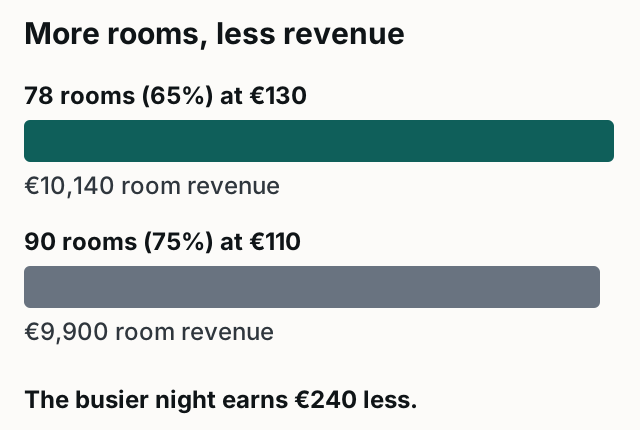
Selling 12 more rooms at €110 earns less than 78 rooms at €130. Occupancy went up and revenue went down. That is why occupancy alone cannot tell you how a night performed.
Where the date is heading
A date that has not arrived yet is still selling. Three numbers tell you where it is heading.
Days to arrival is how far away the night is. Saturday 24 October is 8 days away. Saturday 21 November is 36 days away.
Pickup is the net change in bookings over a period, which is new bookings minus cancellations. Saturday 24 October had 76 rooms booked 7 days ago and 78 today, so its 7-day pickup is +2 rooms.
Booking pace compares what you hold now with what you held at the same point before, usually the same time last year. It tells you whether you are booking faster or slower than you did.
Two kinds of last year
"Last year" can mean two different numbers. Mixing them up is one of the most common mistakes in revenue management.
- Same time last year is what you had on the books last year, for the matching night, at the same number of days to arrival. For Saturday 24 October, the matching night is Saturday 25 October 2025, and the comparison point is 8 days before it.
- Last year's final result is what that night ended with, after every booking and cancellation.
Same time last year tells you where you stand today. Last year's final result tells you where last year ended up. The difference between them is how much last year still sold from this point on.
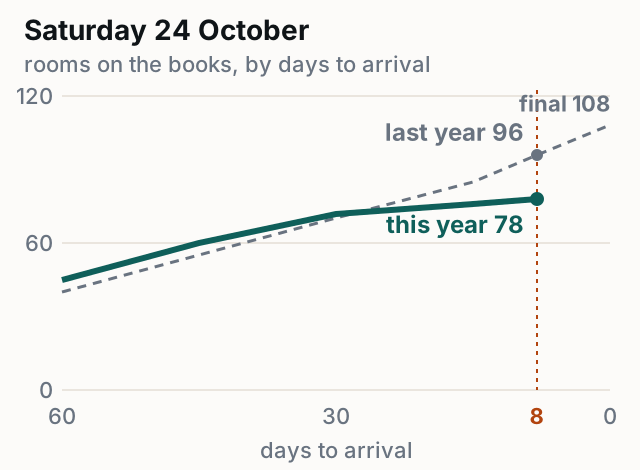
The booking curve shows rooms on the books by days to arrival. Saturday 24 October was ahead of last year until about 30 days out. Then it slowed down while last year kept selling.
Guided practice with Saturday 24 October
Work through these with the table and the curve. Try each one before you open the answer.
- How does today's position compare with the same time last year?
- How many rooms did last year sell in its final 8 days?
- If the next 8 days go like last year's, where will Saturday 24 October finish?
Show the answers
- 78 rooms against 96. You are 18 rooms behind, 65% against 80%.
- 108 final minus 96 at 8 days = 12 rooms.
- 78 + 12 = 90 rooms, which is 75%. Last year finished at 90%. Even a good last week will not close the gap. And the last 7 days brought +2 rooms against +11 last year, so the date is slowing as well as behind.
Now the same reading for Saturday 21 November. It has 78 rooms against 60 at the same time last year, so it is 18 rooms ahead. Its 7-day pickup is +9 against +5 last year, so it is booking faster too. Last year sold another 42 rooms from this point (102 − 60). If this year does the same, the hotel sells out: 78 + 42 = 120.
Independent practice with a Tuesday
Here is a different date for MyDemoHotel. Work out every answer yourself before you open it.
| Tuesday 3 November 2026 | |
|---|---|
| Rooms available | 120 |
| Rooms booked today | 54 |
| Room revenue on the books | €5,130 |
| Rooms booked 7 days ago | 41 |
| Same time last year | 48 rooms |
| Pickup, same 7 days last year | +6 rooms |
| Last year's final result | 72 rooms |
- How many days to arrival?
- Calculate occupancy, ADR and RevPAR.
- Calculate the 7-day pickup.
- Is Tuesday 3 November ahead of or behind its pace? Use two numbers.
Show the answers
- 18 days, from Friday 16 October.
- Occupancy 54 ÷ 120 × 100 = 45%. ADR €5,130 ÷ 54 = €95. RevPAR €5,130 ÷ 120 = €42.75 (check: €95 × 0.45 = €42.75).
- 54 − 41 = +13 rooms.
- Ahead. It holds 54 rooms against 48 at the same time last year, 45% against 40%. And it picked up 13 rooms in 7 days against 6 last year.
A common mistake is to compare 45% with last year's final 60% and call the date behind. Last year's 60% is where the night ended, 18 days later. Compare like with like. Compare today with the same time last year.
Now decide which Saturday needs you today
Go back to the two Saturdays. Write one sentence for each: what you would do today, and the two numbers that justify it.
Show a model answer
Saturday 24 October needs attention today. It is 18 rooms behind the same time last year (78 against 96), and it is slowing: +2 rooms in 7 days against +11 last year. With 8 days left there is little time to change the result.
Saturday 21 November can wait. It is 18 rooms ahead (78 against 60), and booking faster (+9 against +5). At this pace it could sell out, so this is not the date to cut the price. Hold it, and watch the pickup.
Other answers can be right too, if they rest on the right comparisons. "65% is fine" or "65% is low" is not an answer. Both dates are 65%, and they need opposite decisions.
What exactly to do with Saturday 24 October, whether to change the price and by how much, is Lesson 3.
Knowledge check
Do this on your own. It uses a different hotel, so you cannot copy the numbers above.
A 40-room hotel. Today is Friday 16 October 2026. The date is Friday 13 November 2026.
| Rooms booked today | 26 |
| Room revenue on the books | €3,120 |
| Rooms booked 7 days ago | 25 |
| Same time last year | 30 rooms |
| Pickup, same 7 days last year | +4 rooms |
| Last year's final result | 36 rooms |
- Calculate occupancy, ADR and RevPAR.
- Calculate the 7-day pickup.
- Compare today's occupancy with the same time last year, and with last year's final result. Which comparison tells you where the date is heading?
- Is the date ahead of or behind its pace? Give two numbers.
- A colleague says: "RevPAR is room revenue divided by rooms sold." Are they right? What did they calculate?
- This Friday and Saturday 21 November are both 65% booked. Do they need the same decision? Justify your answer in two sentences.
Show the answers and explanations
- Occupancy 26 ÷ 40 × 100 = 65%. ADR €3,120 ÷ 26 = €120. RevPAR €3,120 ÷ 40 = €78 (check: €120 × 0.65 = €78).
- 26 − 25 = +1 room.
- 65% today against 75% at the same time last year, and against 90% final. The same time last year tells you where you stand now. The final result tells you where last year ended up. To see where this year is heading, compare with the same time last year and then look at the pickup.
- Behind. It holds 26 rooms against 30 at the same time last year, and it picked up 1 room against 4 last year.
- No. Room revenue divided by rooms sold is ADR. RevPAR divides by rooms available, sold or not.
- No. Saturday 21 November is ahead of last year and booking faster, so it can be held. This Friday is behind and slowing, with 28 days left, so it needs a closer look now.
If you got question 3 or 4 wrong, reread "Two kinds of last year". If you got question 5 wrong, reread "RevPAR".
Use it at your hotel
Pick next Saturday at your own hotel. Fill in this table from your own systems, taking every number from the same system at the same time.
| Next Saturday | Your numbers |
|---|---|
| Days to arrival | |
| Rooms booked and occupancy | |
| ADR and RevPAR | |
| Same time last year | |
| Pickup, last 7 days, and the same 7 days last year | |
| Last year's final result | |
| Ahead or behind? |
If you cannot find the same time last year in your systems, write down what you hold today for a date a year from now. In a year's time you will have it.
Keep learning
- Next, Lesson 3, "The Price Is Not the Strategy": what to do once you know a date is behind.
- Back to Lesson 1, "From Madness to Method", if the numbers in your systems disagree.
- Hotel Revenue Management: A Complete Practical Guide: pickup, pace and booking curves in more depth.
- Hotel Market Intelligence, Rate Shopping and Analytics: where market numbers come from, and how to read them.